

Eight to ten windows is a project, not a purchase
At three bedrooms the thing you are buying changes. One or two windows is a purchase: you choose, it arrives, it is fitted. Eight to ten is a small project, with a sequence and a way of going wrong that has nothing to do with fabric.
What goes wrong is rarely the curtains. It is that the rooms were decided one at a time, weeks apart, and the result does not hang together.
Consistency is the part people get wrong
In a three-bedroom you can see more than one window at once. Stand in the hallway of most Dubai three-beds and two doorways are open, with a third visible past them. That sightline is what exposes inconsistency, and three things give it away.
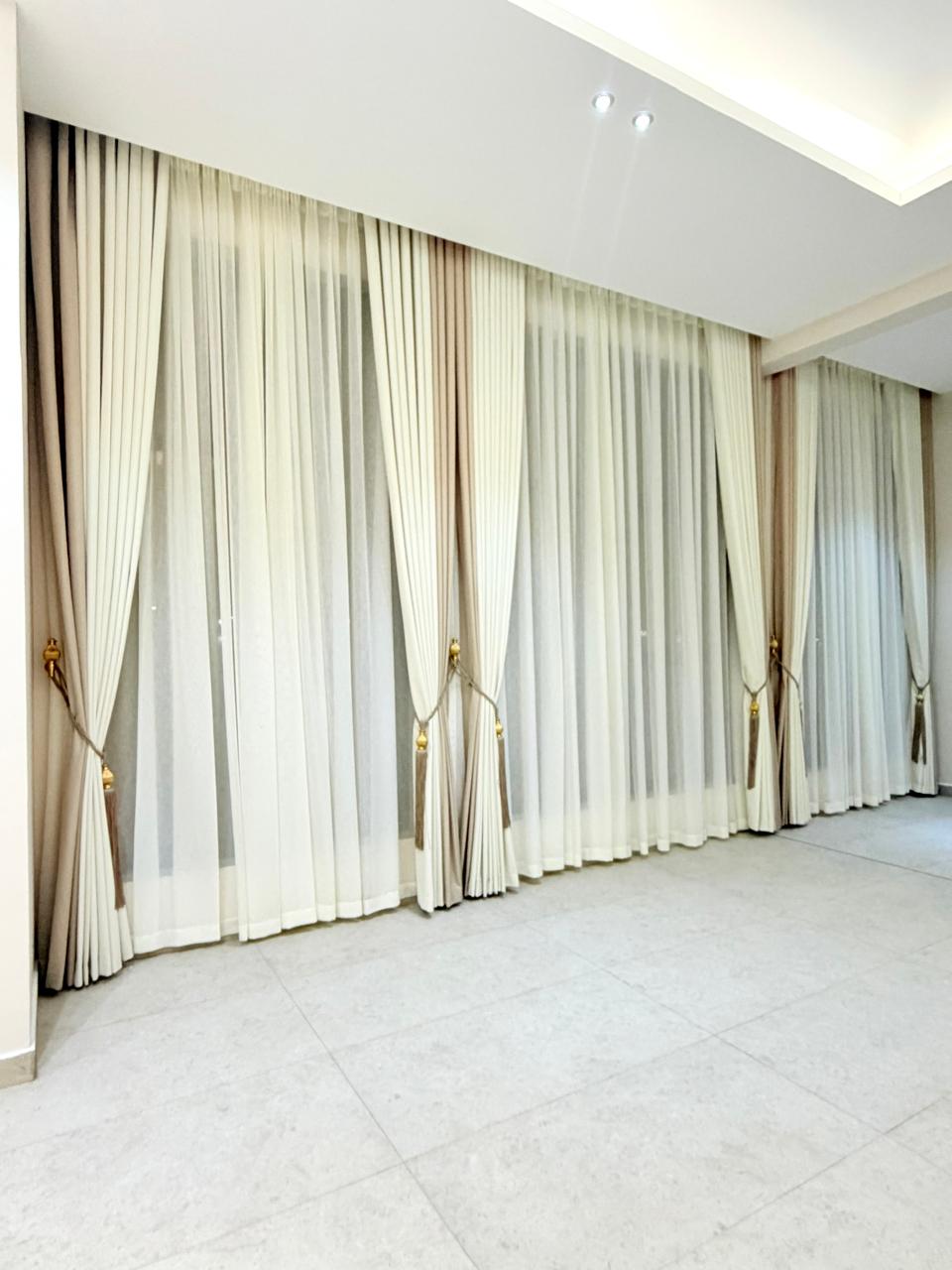
Track height. If the master track is fixed near the slab and the second bedroom track sits at window height because that room was done later, the doorways read as different ceiling heights. Nothing about the fabric fixes it.
Heading. A wave in one room and a pinch pleat in the next does not read as considered. It reads as two orders. Pick the heading for the apartment, then vary fabric within it — compare wave and pinch pleat before the measurement.
Colour temperature. Two neutrals that look identical in a fabric book can sit warm and cool against each other in daylight. The fix is holding them together, in your own hallway, at the hour you walk through it. That is one reason we bring the books to the home.
None of that means every room matches. It means the rooms are decided in the same conversation.
Room by room, and why they differ
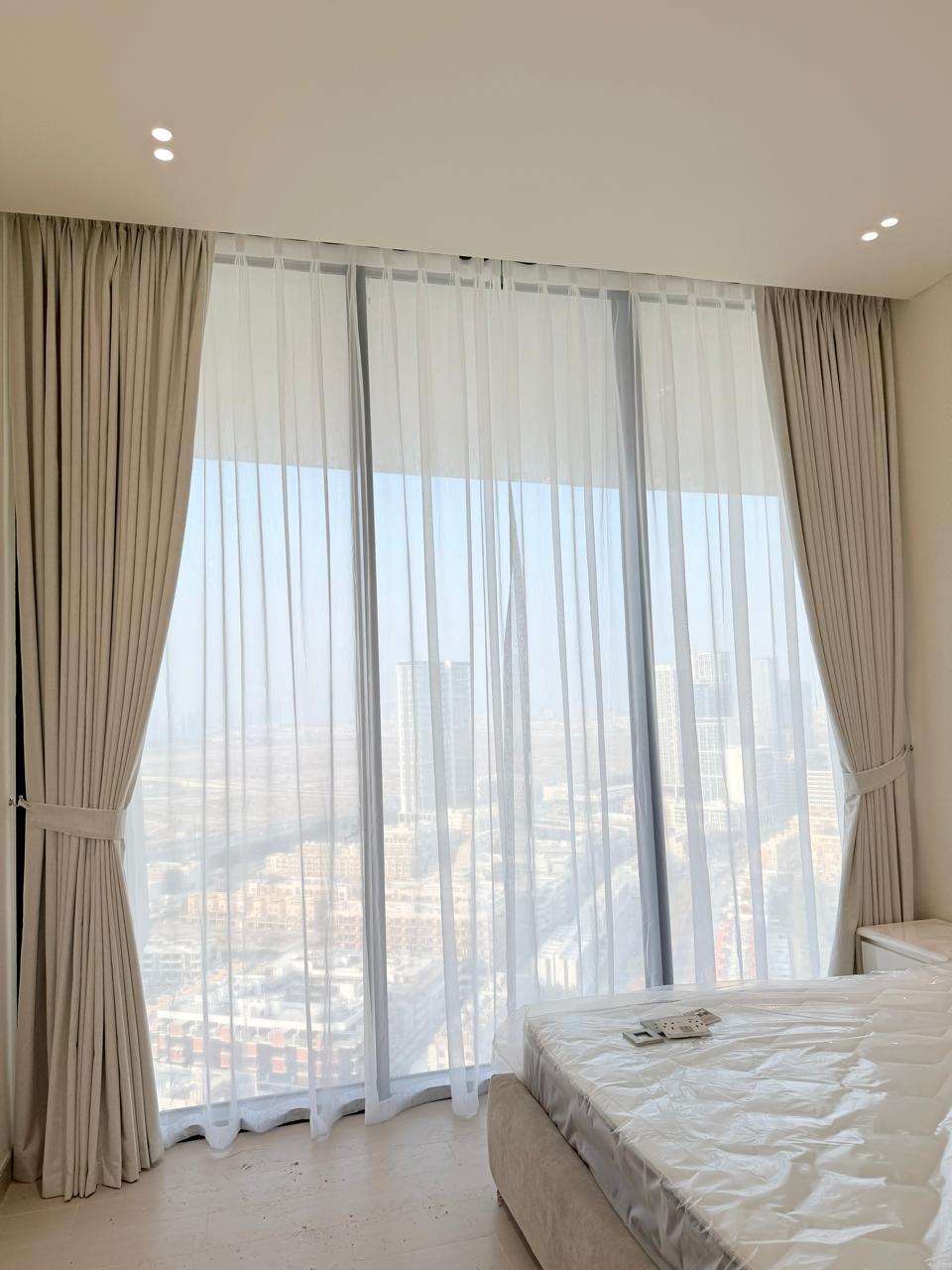
The master is a coverage problem. The sun is up before half past five for much of the year, and opaque fabric does not make a dark room on its own, because light arrives over the track, down the sides and under the hem. Ceiling-fixed track, run past the reveal, a return at each end, an overlap in the middle. Where somebody sleeps in the day, side channels close the last of it. Our blackout page covers the three leaks.
Children's rooms need afternoon darkness rather than night-time darkness, because naps happen when the room is brightest. They get cordless operation as standard — a safety rule here, not an upgrade.
The guest room or study is where we will tell you to spend less, or differently. A guest room used a dozen nights a year does not need a master specification. A study does not want blackout at all: the problem there is glare on a screen in the afternoon, and blackout answers it by making you work with the lights on.
Living and dining is an evening privacy problem more than a light one. The window that felt private at three shows the room in outline at eight. Two layers on a double track, specified as a double from the start because a double bracket carries more load and stands further off the wall. Our sheers page explains what the open weave is doing.
Kitchen and bathrooms are blinds. Grease and dust wipe off a flat surface and never come out of fabric.
Where motorisation actually earns its place
Three-bedroom homes are where the motor question becomes real, and the honest answer is that two windows usually earn one, not eight.
A motor earns its place on a window you cannot reach, on a span wide and heavy enough that hauling it daily wears the track, and on glass behind a sofa, a dining table or a bed where the leading edge is awkward. In most three-beds that is the living and dining glass. It does not earn its place on a guest room, a study you enter twice a week, a kitchen, or any window you walk past ten times a day.
Two things we will not do. We will not promise smart-home integration from a specification sheet, because a brand name on a wall panel does not tell you what the curtain protocol behind it supports. And we will not motorise a track that was not specified for it. The survey is free and technical, and it happens at your property before we quote. Detail in our motorised range and the motor guide.
What we would tell you not to buy
The same specification in all eight windows. It is the tidiest quote and the worst value in this size of home.
Blackout in the study. Interlining in a rented apartment. Three-pass lining in a guest room. A heavy pinch pleat in a room with a flat ceiling and a square reveal, where it will stack across the glass you paid for.
And a lump sum for the whole apartment, from anyone. A single figure cannot be interrogated, which means the rooms you would have cut stay hidden inside it.
Choose your level
- Essential — quality fabrics
- Signature — premium fabrics, three-pass blackout lining (most chosen)
- Atelier — luxury fabrics, motorised living areas
Every level includes the correct track for your window, rated for the fabric weight. We do not fit a cheaper track at a cheaper level.
Mix them by room. Signature through the master, living and dining with Essential in the guest room and study is the split most three-bedroom clients choose.
How it works, and what the price includes
A supervisor visits free, about 45 minutes, studies the light in every room, brings the fabric books to you, and measures every window twice. Within 24 hours you receive a written window-by-window quote, never a lump sum — fabric, making, lining, track, brackets, the correct fixings for your wall type, delivery, installation and hand-dressing all inside one number per window. Nothing is added later, you can adjust one room without re-quoting the home, and the quote stands for 30 days with no follow-up pressure. Installation is two to five working days from the measurement, on a date written into your contract rather than a range; if we miss it, your first professional curtain clean is free. One-year warranty on mechanical parts and labour, and every window we measure is kept on file permanently. All seven emirates, no travel surcharge. See how it works and what curtains really cost in Dubai.
How it runs
Installation in one day by a named installation team. A written date in your contract, not a range.
Questions we get asked
Does every room have to use the same fabric?
No, and it usually should not. What has to be consistent is track height and heading, because those are what you see across a hallway.
Can eight to ten windows really go in one day?
Normally yes. We return about a week later, free, to untie the hand-dressing.
Which windows should we motorise?
Usually the living and dining glass, and anything behind furniture. We will tell you at the survey which ones do not earn it.
Can we order some rooms now and the rest next year?
Yes. The quote is per window and your measurements are kept permanently, so the later rooms need no second survey and will match.
What if one panel is damaged in three years?
Send us the room. We hold the dimensions, fabric, lining and track specification, so a matching replacement is made without measuring again.
Book your free measurement — 45 minutes, no obligation. We fit across Dubai Hills Estate, Downtown, Al Furjan and every community we serve.