

Made to measure
Sheers
A sheer works by day and stops working the moment your lights come on.
By day your room is darker than the street, so an open weave gives you privacy and a view at once. After dark, with the lights on, that reverses exactly: a lit room behind a sheer reads clearly from the tower opposite. That is not a reason to avoid sheers.
Compare honestly
“Sheer” is not one fabric.
| Sheer | Light | Daytime privacy | Character |
|---|---|---|---|
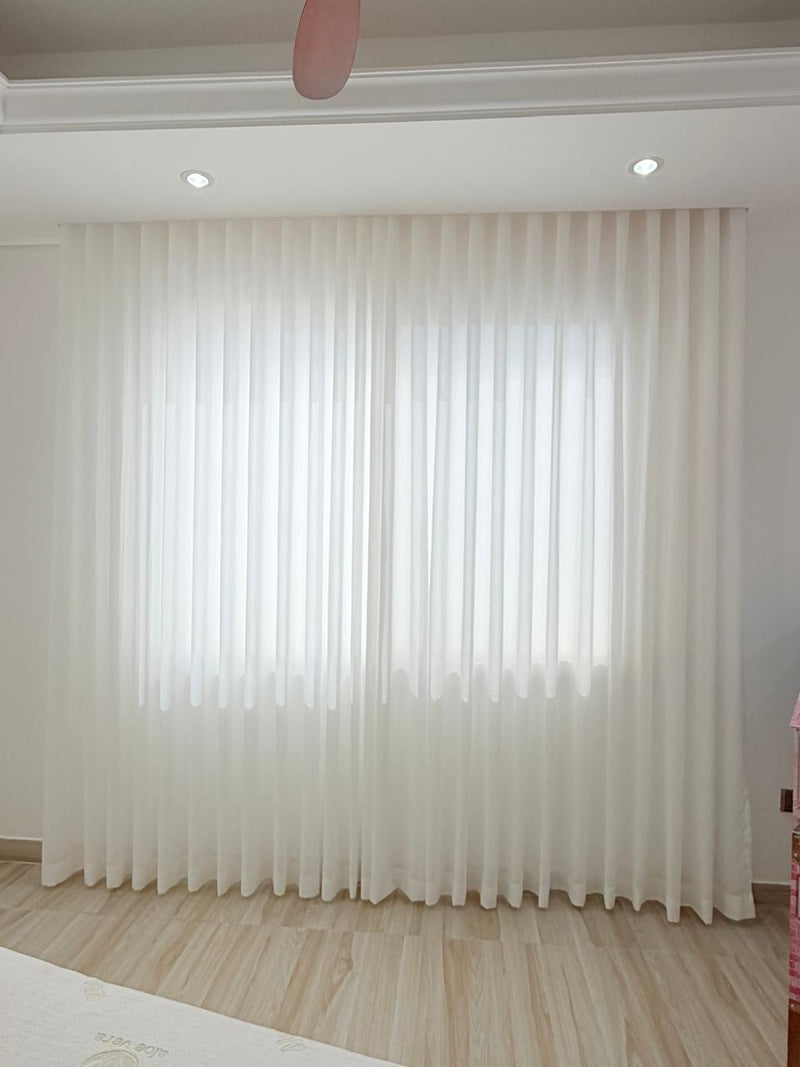
| Voile | It turns light into a clean wash rather than patches. | Gives dependable daytime privacy. | Its weakness is character: flat close up. |
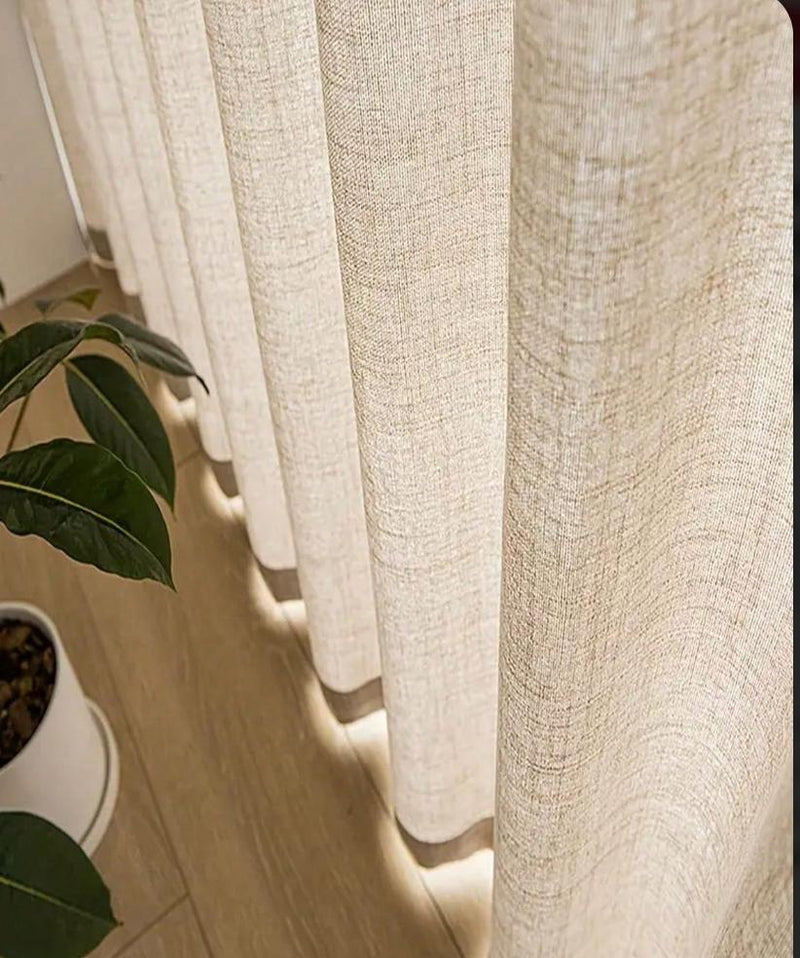
| Linen sheer | Light comes through warm instead of white. | You keep more view than voile and less privacy, because the eye reads through the gaps. | The drape is far better. It creases and holds dust. |
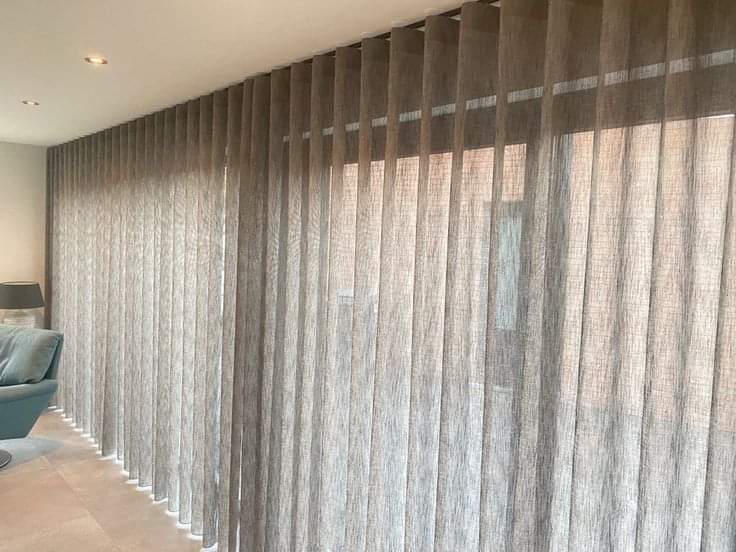
| Textured or slub sheer | It scatters light rather than blocking it. | Texture breaks a sightline better than plain voile at the same openness. | The most interesting to look at, and right where the window is the room’s only feature. |
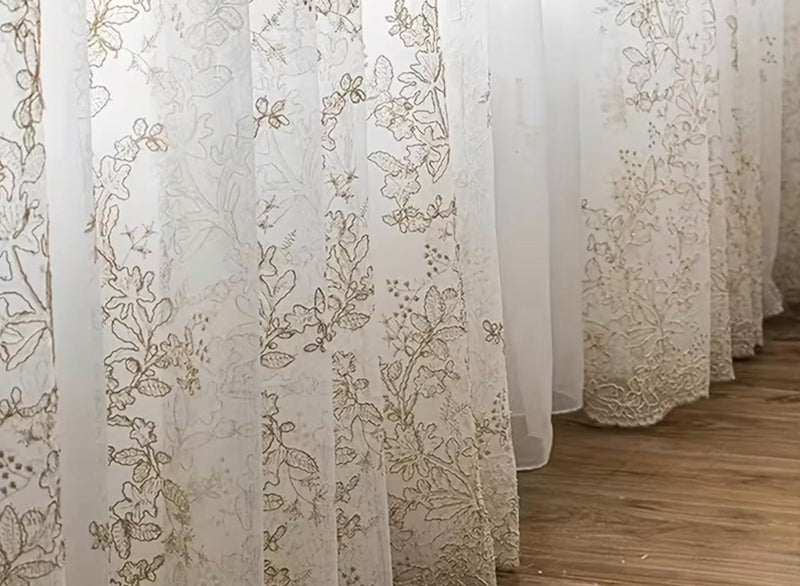
| Embroidered | The stitch blocks light where it is dense and the ground between motifs is usually open, so the filter is mottled rather than even. | Choose it for decoration, not privacy. | A base sheer with pattern stitched in. |
Two sheers photographed side by side look identical and behave nothing alike.
The layering decision comes first, because it decides the track
Most Dubai apartments need a sheer and a blackout layer: filtered daylight when you want it, darkness and privacy when you do not. That is a double track, and it must be specified for two layers from the start — a double bracket carries more load and stands further off the wall. Retrofitting a second layer to a single track usually means replacing it. Decide at the measurement, even if you fit only the sheer now. What a blackout layer does and does not do alone is on our blackout page.
Which windows should not have sheers
Bathrooms: the humidity and the sightline are both wrong, and a sheer there is decoration pretending to be privacy. Fit a blind. Ground-floor and podium-level rooms overlooked at close range: openness that works across fifteen metres does not work across two. And any window whose only job is darkness — a nursery, a media room, a bedroom for night shifts — where a sheer is one more thing to draw and one more edge for light to find.
Three Dubai problems nobody mentions
Dust shows here first. A pale open weave is the most dust-visible textile in the apartment: fine dust settles into the gaps rather than onto a surface and greys the panel evenly, so it reads as tired rather than dirty. A vacuum brush every month or two keeps it. A year of neglect does not come back.
AC airflow keeps a light sheer moving. Vents here usually sit near the glass, and a sheer in that draught drifts all day — charming for a week, then irritating, and it wears the leading edge against the track. The fix is hem weighting matched to the fabric.
Reflected glare arrives low. Sun off a pool, off water, off pale paving comes up from below. A sheer is specified for light coming down and will not stop it. That window needs a second layer or a blind.
What ages, and what fades first
Sheers go at the edges first: the leading edge takes the handling, the hem takes the draught and the floor dust. Colour matters less than with heavy fabric — most sheers are white or a light neutral, and those yellow rather than fade. What matters in a west-facing room is that the lining behind the layered curtain, not the sheer, takes the ultraviolet and goes brittle first; when it does, the whole window stops hanging properly. The fibre detail is in choosing curtain fabric for a Dubai home.
Room by room
Living room: sheer plus blackout on a double track, almost always. Bedroom: the same, blackout doing the work. Home office: a denser sheer, because screen glare is a daylight problem. Majlis: embroidered or textured, layered. Balcony doors: a smooth weave, weighted hem. Kitchen and bathroom: not a sheer.
Openness cannot be judged on a screen
Two sheers photographed side by side look identical and behave nothing alike. So a supervisor visits free, with the fabric books, and holds each against your own glass, in your own light, at the time of day you use the room — and where it matters, again after dark. That is the only honest test. Every window is measured twice, and you get one written price per finished window within 24 hours. See how it works, compare headings in wave and pinch pleat, or book a free measurement.


Good to know
Questions we get asked
Yes — with your lights on and darkness outside, they see the room, not shapes. Every sheer does this; openness only changes how much. A second layer is the only fix.
In a bedroom, yes. In a living room facing another tower at close range, yes by evening. On a high floor with nothing looking in, a sheer alone can be enough.
Only if the track was specified for two layers. On a single track it usually means a new track and fixings — so tell us at the measurement, even if you fit one layer now.
Vacuum with a brush head every month or two; that is what keeps them looking new. When a full clean is due, have them cleaned professionally, not machine washed — sheers shrink and lose their hang.
Mostly glare. A sheer scatters light but has no mass and traps no air, so it does little for heat. On west-facing glass that work falls to the lined layer behind it.
Free measurement
Let’s start with a free measurement
45 minutes, no obligation. We study the light in every room, measure every window twice, and bring the fabric books to you.
+971 58 663 3160Every day, 10:00 AM – 10:00 PM