

Made to measure
Motorized
Every motorised curtain sold in Dubai is advertised as silent. None of them are.
A good motor is a soft hum for a few seconds; a cheap one is a whirr you hear through a closed door. In a bedroom at six in the morning it is the entire experience. We fit motors, and still talk most people out of motorising every window — two or three in an apartment usually earn one.
Which windows earn a motor
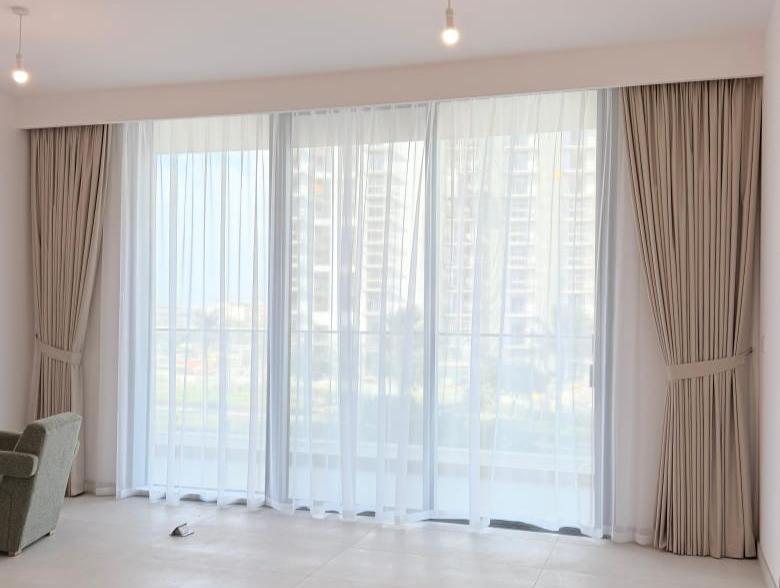
Windows you cannot reach — double-height glass, a stairwell, anything needing a ladder. Very wide or heavy spans, where hauling a lined curtain daily wears the track out. Windows behind a sofa or a bed. A bedroom, if you want the curtains to open before you do. Not small windows, guest rooms, kitchens or bathrooms: those buy you a battery to charge and a device to pair.
The track is the specification, not the motor
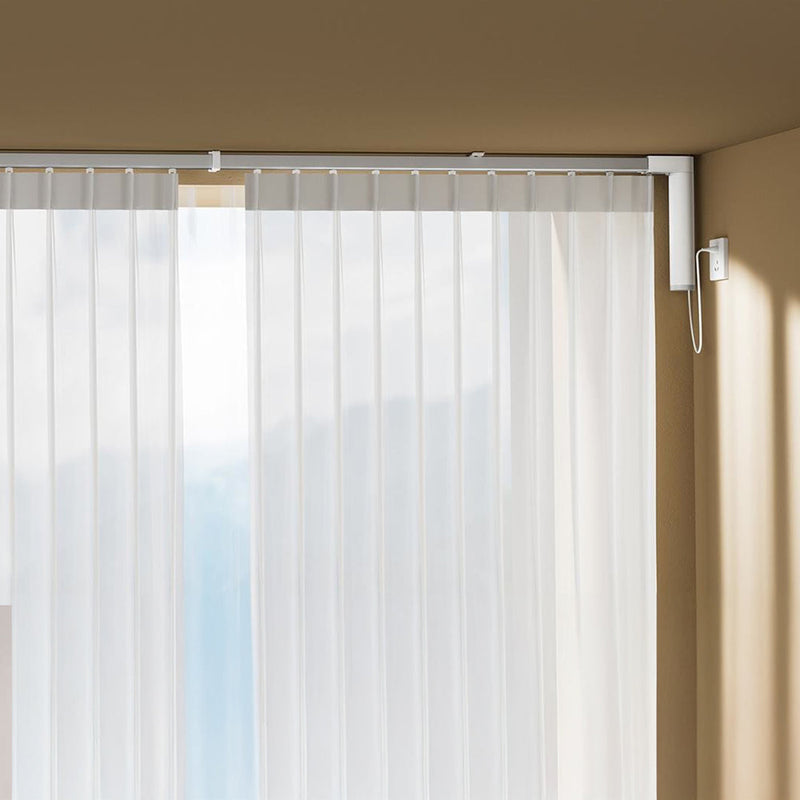
People choose a motor and assume any track will carry it. Not every motor works on every track. Motor and track are a matched pair — drive type, carrier spacing and end stops have to correspond — and a motor fitted to a track it was not designed for will run, badly, until something gives.
Two rules follow. A track specified for hand-pulling is not automatically fit to be motorised — a motor applies the same force in the same place every time and never eases off the way a hand does, so it must be rated for the span and weight and fixed into something that holds that load. A wave track is its own case: every carrier works, so load per bracket is higher and a motorised wave must be specified as one from the start.
Fabric weight against motor torque
This is the specification nobody publishes, and where most premature failures begin. A motor is rated to move a certain mass over a given span. Three-pass blackout lining, interlining, or a sheer and a blackout layer driven together on a double track can put several times the load of a light unlined curtain on one motor.
An under-specified motor does not announce itself. It works on installation day, and on a showroom stand with nothing attached it sounds quieter than the correctly sized one will on your window. What you get is a motor running at the top of its range every cycle: it slows, misses the closed position, and is dead in about three years. So we size against the finished weight of the panel — fabric, lining, interlining, heading and hardware — not the width of the window.
Battery or wired, as a decision
The question is not which is better, but where the motor lives and who can reach it. Battery motors need no cabling and retrofit in a day, which is why most apartment work is battery; they need recharging periodically. Wired motors never need charging and last longer, but need power at the track — decided before the ceiling is closed up. In a finished apartment that means surface trunking painted to match, a visible cable, or battery instead.
The trap is putting a battery motor on the high window that made you motorise in the first place. That one wants power run to it, or a plan for who brings the ladder.
Smart home, checked rather than assumed
Most motors do not talk to Alexa, Google or Apple Home on their own. They speak a radio protocol and need a bridge or hub in between — a real component needing a place to sit and a power supply. Anyone implying your voice assistant will simply find the curtains is skipping it.
We work with Apple Home, Google, Alexa, Control4, KNX and Lutron. What we will not do is promise integration from a specification sheet: a developer-fitted panel does not always mean the curtain protocol behind it is supported, and bridging between ecosystems sometimes works and sometimes does not. The check happens at your property before we quote.
Motorised blinds are a different problem
A blind motor lifts against gravity in a tube; a curtain motor drags a mass sideways. Blinds are the easier retrofit and the smaller battery, and on a bank of them the case is that they should all move together.
Retrofitting a finished apartment
Realistically: a battery motor on a new track, with existing panels re-headed if sound — a day per room. What is not realistic is motorising whatever track is already up there: it must be the right type, sound and correctly fixed, and developer-fitted tracks usually fail one of those.
In older towers, early systems reach end of life, go out of production or lose the only remote that pairs to them, and replacement then means a new track as well as a new motor. JLT is where we see this most. What fails and when is in the guide.
How we work
The survey is free and technical: which system your apartment runs, whether power can reach the track, what the ceiling above the window is made of, the finished weight of the panel, and an honest inspection of any track or motor already there. We will say which windows are worth motorising and which are not. Then one written price per finished window within 24 hours — motor, track, brackets, wiring or batteries, programming and installation inside it — fitted on the contract date, with a one-year warranty on motors and electronics. See how it works, or book a free survey.


Good to know
Questions we get asked
A few seconds of soft hum. Ask to hear it on a loaded track, not a showroom stand — an unloaded motor tells you nothing.
Usually yes. Most motors need a bridge, which needs somewhere to live and a power supply. We confirm that at the survey.
Sometimes. It has to be the right type for the motor, sound and correctly fixed. We inspect before quoting, never promise by phone.
Only if the motor is sized for it — we specify against the finished weight of the panel, not the width of the window.
Battery motors carry on. Wired motors stop, and every track we fit can still be drawn by hand.
Free measurement
Let’s start with a free measurement
45 minutes, no obligation. We study the light in every room, measure every window twice, and bring the fabric books to you.
+971 58 663 3160Every day, 10:00 AM – 10:00 PM