
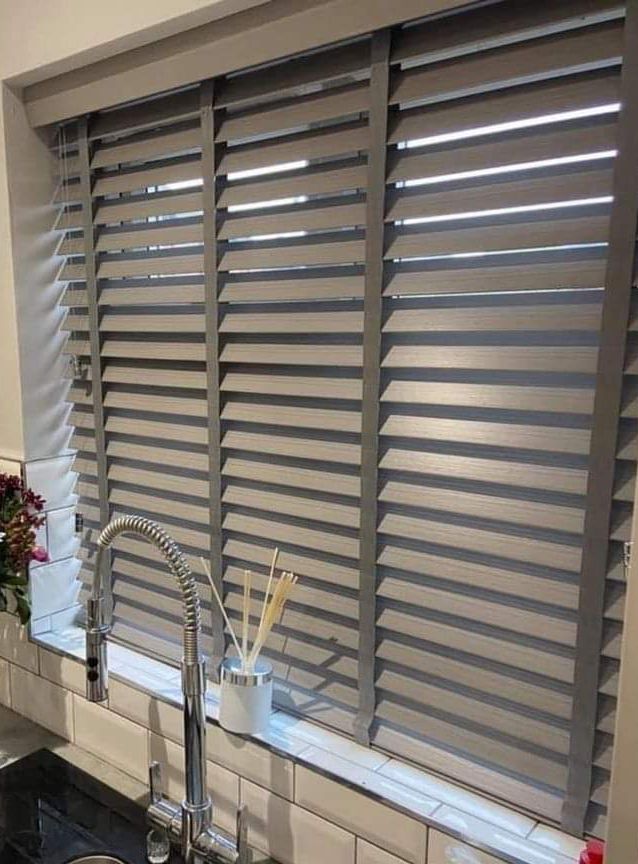

The one thing a venetian does that no other blind does
Every other blind is a choice between covered and not covered: a roller is down or up, a roman is down or stacked at the head. A venetian adds a third setting: down, but tilted. The slats turn on their ladder tapes and you set the angle: light thrown up at the ceiling, dropped toward the floor, or shut almost flat.
That matters here for one reason. The problem in most Dubai rooms is not too much light, but too much light from one direction, at one hour of the day. A screen goes unreadable in the afternoon. A worktop turns into a glare strip. Pulling a roller down solves it by making you turn the lights on. A venetian points the light somewhere else instead, and you keep the daylight and most of the view.
If that is not your problem, a venetian is probably not your blind — the rest of the range is on blinds.
Aluminium or faux-wood
We fit both. Neither is better; they fail differently and the room decides.
Aluminium is thin and light. It stacks shallow, fits a narrow reveal, and does not care about steam, which is why it ends up in bathrooms and utility rooms. Two things come with it. It is the noisier of the two — slats knock together in the draught from an air-conditioning vent — and it dents. A slat caught by a door stays bent, and the repair is a new slat.
Faux-wood is a moulded PVC or composite slat with a painted finish. It is quieter, looks softer in a living space, and holds its shape in humidity. What you pay for that is weight. A wide one is heavy to raise by hand twice a day for years, so past a certain width we would rather motorise it or split it into two than sell you something you stop using.
What usually goes wrong
It is measured for the opening, not for the tilt. Slats need room to rotate. In a shallow reveal, or where a handle stands proud of the frame, a blind that fits on paper catches the moment you turn the wand. That is a survey problem, which is why we measure at the window.
It is ordered too wide. Past a sensible width it bows in the middle, the slats stop sitting level, and the tilt goes uneven. The answer is two blinds on one board, aligned to read as one.
The mechanism is the cheap part. Slats rarely fail. Tilt rods, cord locks and headrails do, and they are what separates a blind still working in five years from one that is not.
Nobody asks how it will be cleaned. Every slat is a horizontal ledge, and a wide blind has dozens. It is a wipe-down rather than a chore, but it has to happen.
Where we would not fit one
A bedroom you want dark. A closed venetian still leaks light between every slat and down both edges. It is not a blackout and cannot be made into one. That room wants a lined curtain, or a blackout roller with side channels.
A door you walk through daily. The blind has to be fully raised every time, and the stack sits in the head of the opening. A curtain that draws aside is right there.
A window you cannot reach. A venetian is operated more than any other blind. If it needs a ladder, motorise it or choose something else.
A room that wants softness. A venetian is hardware and reads as hardware. Where a room needs cloth, a roman blind is the better answer. The wider argument is in curtains or blinds.
Room by room
Kitchen. The strongest case in the house. Grease and dust wipe off a slat and never come out of fabric, and the tilt kills worktop glare without darkening the room.
Bathroom and utility. Aluminium. Humidity that would ruin fabric does nothing to it, and you can tilt for privacy while keeping daylight.
Home office. The other strong case: screen glare moves through the day and a venetian tracks it. Same reasoning as office and commercial work.
Living room and bedroom. Sometimes, in faux-wood, usually alongside curtains rather than instead of them — and in a bedroom only where darkness is not the priority.
How we measure and fit
A supervisor comes to you, free, with slat samples, and checks what decides whether a venetian works there: reveal depth, whether handles foul the tilt, what the wall above is made of, and how wide is too wide. You see slat colours against your own glass, not showroom light.
Then one written price per finished window within 24 hours, with the blind, mechanism, fixings, delivery and installation inside that number. Nothing is added later. We fit on the date written into your contract, not a range, with a one-year mechanical and labour warranty. Manufacture and installation are by partners we choose and audit; if anything is wrong, you deal with us. The full process is in how it works.
Questions people actually ask
Will a venetian black out a bedroom?
No. Light comes between the slats and down both edges however tightly you close it. If the room must be dark, that is a lined curtain or a blackout roller with side channels.
Are they noisy?
Aluminium can be, in a draught from an air-conditioning vent. Faux-wood is quieter because the slats are heavier. If the window sits under a vent, say so at the visit.
How do you clean them?
A dry cloth or vacuum brush along the slats, tilted flat. Quick, but needed more often than on a flat blind.
Can we have one in a child's room?
Only cordless or motorised. A looped cord within reach of a small child is a real strangulation hazard, and we do not fit corded blinds in children's rooms at all.