
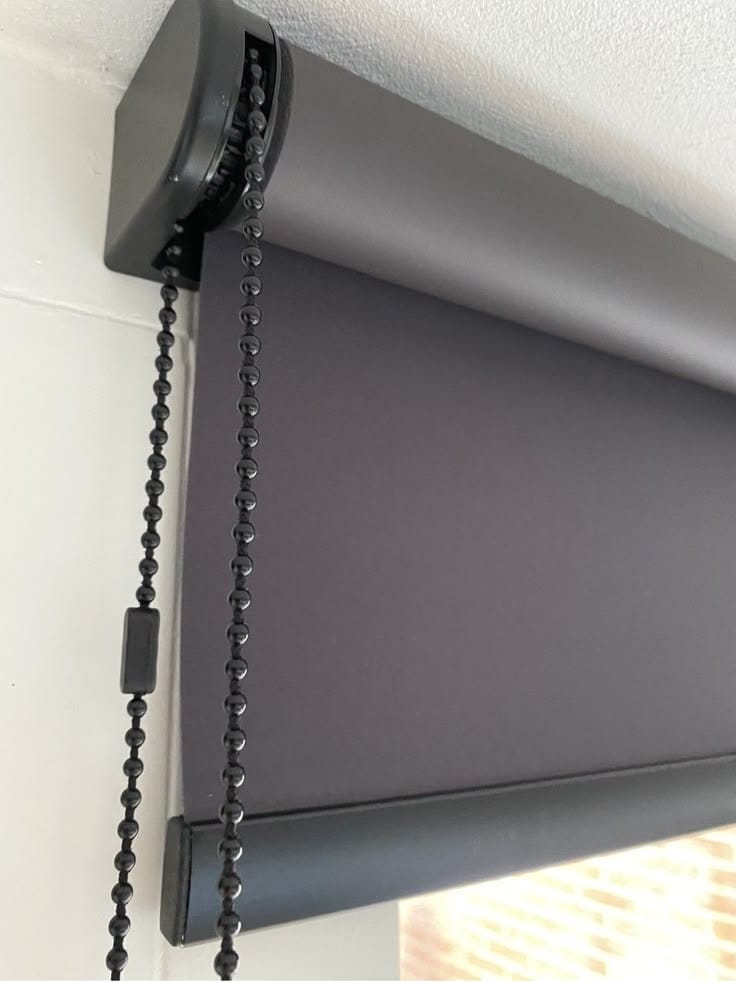
Blinds
Roller and Zebra Blinds
One written price per finished window, after we’ve measured — fabric, lining, track, fixings, fitting and warranty all inside it. Nothing added later.
Roller and zebra blinds are the same mechanism wearing two different fabrics: one cloth wound onto a tube at the head of the window. Down, it covers the glass; up, it disappears. That simplicity is the appeal — and it is where the honest limitations sit.
Roller or zebra, and when the second layer earns its place
A roller is one continuous fabric: it is either over the glass or it is not. A zebra — also sold as day-and-night — is a double layer printed in alternating sheer and solid bands. Move it a few centimetres and one layer slides against the other: aligned, the solid bands give near-full coverage; apart, the sheer bands open into stripes of filtered light. You dial the light without opening the window.
That earns its money where the right amount of light changes hour by hour — a home office facing the sun, or a living room overlooking a neighbouring tower. In a bedroom it is usually the wrong buy, and we will say so. A bedroom wants the blind fully down and fully shut, which a plain roller does with fewer moving parts and a cleaner seal. A zebra never truly blacks out: light finds the joins.
The side gap on blackout rollers — the part most companies never mention
A roller sits inside the reveal on brackets, and the fabric must be cut narrower than the opening so it can turn without catching the sides. That leaves a gap down each edge, about a finger's width. The fabric is blackout. The gap is not. The sun is up before half past five for much of the year, and both edges glow. It is the most common complaint about blackout blinds here.
Side channels close it — a slim track down each side of the reveal that the fabric runs inside. They work, but they must be specified before the blind is made, because the fabric is cut narrower again to suit them. They cannot be added later, so if nobody has mentioned them, ask before you sign.
Blackout, dim-out and sunscreen
Blackout is coated so no light passes through the cloth: bedrooms, nurseries, night shifts. Dim-out is dense but uncoated — most of the light goes, a soft glow stays: living rooms and guest rooms. Sunscreen is an open weave that cuts heat and glare while keeping the view — the right answer for a window you want to keep looking through. It gives daytime privacy only: after dark, with the lights on, the room reads from outside. More on that in curtains or blinds: an honest answer for Dubai homes.
Cassette or open roll
An open roll leaves the tube and brackets visible. A cassette is an aluminium headbox enclosing it: it keeps desert dust off the tube and closes the gap at the top where light spills back over. On a blackout bedroom blind with side channels it completes the seal and earns its place. On a kitchen or bathroom window, an open roll is fine.
Chain, cordless or motorised
A chain is reliable and simple to replace. But a looped chain within reach of a small child is a real strangulation hazard, not a theoretical one. In any room a child uses we fit cordless or motorised as standard, and will not install a corded blind there. Motorisation also suits high windows, heavy blinds, and rooms where several move together.
Where they beat curtains — and where they lose
They win wherever fabric would get dirty or be in the way: kitchens, where grease and dust wipe off a flat surface but never come out of a curtain; bathrooms, for the humidity and the lack of wall to stack onto; small windows, where a curtain swallows the wall; offices, where glare needs tuning through the day.
They lose on floor-to-ceiling glass, where one wide roller becomes a long heavy roll that reads industrial and runs those side gaps the full height of the room. They also lose on heat: a roller is a thin layer with no trapped air behind it, where a lined curtain uses mass and an air pocket. On west-facing glass the answer is often both — see our room-by-room comparison, or the range in blinds.
Measuring: inside or outside the reveal
Inside the reveal is the neat fit — flush in the opening, built in. It costs you the side gaps above, and on a small window the rolled-up blind eats the top of your daylight. Face fixing outside the reveal overlaps the edges and kills both the side leak and the top spill, which is why blackout bedrooms often end up face fixed. It costs you neatness: it stands proud and can foul a handle.
How we work
A supervisor visits your home free, with the fabric books, so you choose in your own light. Every window is measured twice. Within 24 hours you get one written price per finished window — blind, cassette or channels, mechanism, fixings, delivery and fitting, all in that number. Nothing is added later. We fit on the date in your contract, not a range, and everything carries a one-year mechanical and labour warranty. See how it works and our guarantee, or book a free measurement.
Questions we get asked
Do blackout roller blinds actually black out a room?
Not on their own. Light comes down both sides, between the blind and the reveal. Side channels, or a face-fixed blind that overlaps the opening, are what make a room dark — and both must be decided before it is made.
Is a zebra worth it over a plain roller?
In a home office or a living room facing another building, yes. In a bedroom, no — buy the plain roller and put the difference into blackout fabric and channels.
Can we have blinds in a child's room safely?
Yes, and we insist on it. Cordless or motorised is standard in any room a child uses; we do not fit corded blinds there at all.
Can a roller and a curtain go on the same window?
Often that is the best specification, especially on floor-to-ceiling glass: the roller sits at the glass, a lined curtain over it, each moving independently.
45 minutes, no obligation. Free supervisor visit, free measurement, free written quotation and free installation.
Ready when you are
Let's dress your windows
Book a free consultation and we'll bring fabrics, samples and expertise straight to your home.
Every day · 10:00 AM – 10:00 PM · Serving Dubai, Abu Dhabi, Sharjah, Ajman, Ras Al Khaimah, Fujairah & Umm Al Quwain